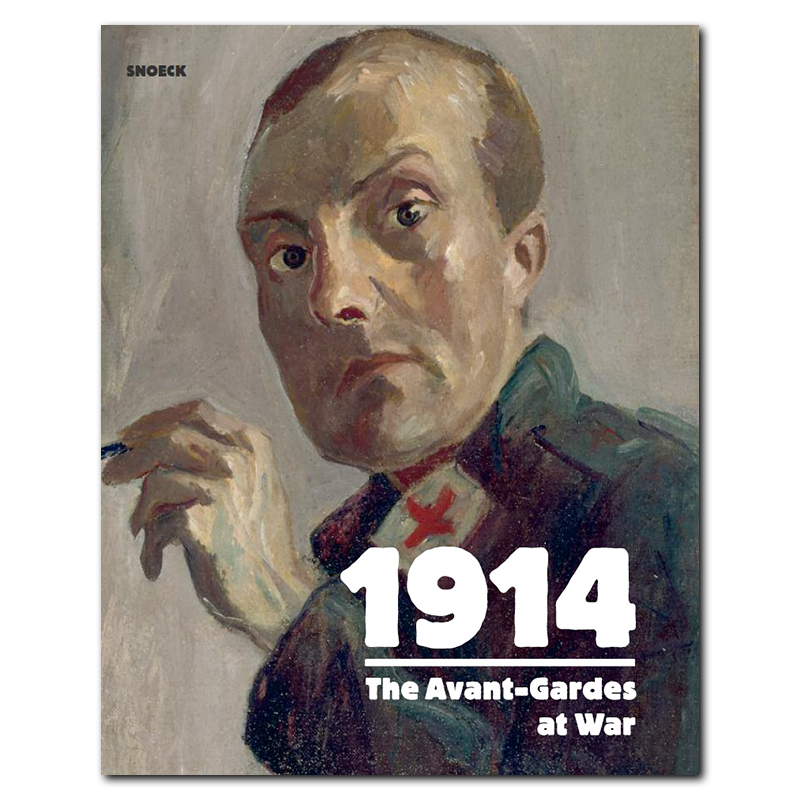
1914 The Avant-Gardes at War | Cat. Bundeskunsthalle Bonn
inkl. MwSt. und zzgl. Shipping costs
- 2014
- 352 pages
- 28 × 24,5 cm
- 400 colour illustrations
- bound with dust jacket
- ISBN: 978-3-86442-053-5
- Edition: German
- Edited by: the Bundeskunsthalle Bonn, curated by Uwe M. Schneede
- Texts by: Régine Bonnefoit and Gertrud Held, Uwe Fleckner, Eckhart Gillen, Christine Hopfengart, Lucian Hölscher, Friederike Kitschen, Joes Segal, Uwe M. Schneede, Jay Winter and biographical information on the artists for the years 1914 to 1918 by Natascha Bolle
Because of a deployment of technology and materiel that burst all human proportion, the First World War is regarded as the „primal catastrophe of the 20th century“ – a century whose moral nadir was then to be the National Socialist policy of war and extermination. Yet those worlds that collapsed in 1914, when 70 million soldiers in Europe, Africa and Asia entered a war that went on to cost 17 million people their lives – those worlds had already grown brittle in the years before, and not a few writers, musicians and artists had long since wearied of them and therefore, like many of their fellow citizens, greeted the outbreak of war with jubilation. Franz Marc – in accord with countless statements by his contemporaries – summed up this zeitgeist as follows: „In our epoch of the great struggle for a new art we fight as ’savages‘, the unorganised against an old, organised power. The struggle seems unequal; but in matters of the spirit it is never numbers that triumph, but the strength of ideas.“ The exhibition at the Bundeskunsthalle in Bonn and the catalogue carefully edited by the curator Uwe M. Schneede by no means merely assemble the familiar sources and protagonists; they take the decisive step further by tracing the processes of transmission within the international art movements of the period. How did these movements come into the war, pass through it and emerge from it? What remained, how were the avant-gardes reshaped or deformed and turned into the starting point of an entirely new self-understanding in art? Which intermediate steps can be reconstructed, under what historical conditions, and in what relation do Expressionism, Cubism, Dadaism or other conceptions of art competing with one another into the 1930s stand? This immense cultural step – one is almost tempted to call it a step in the history of humankind – which carried the 20th century through every high and low, is set out in many ways by means of works, photographs and personal testimonies. A minor sensation along the way is the fact that almost every one of the protagonists had himself photographed in uniform in his studio – and several of the paintings visible on the walls in the background of these photographs are also shown in the book and in the exhibition.
Works in the exhibition by: Jean Arp, Roberto Marcello Iras Baldessari, Ernst Barlach, Max Beckmann, Carlo Carrà, Lovis Corinth, Robert Delaunay, Otto Dix, Marcel Duchamp, Raoul Dufy, Heinrich Ehmsen, Conrad Felixmüller, André Fraye, August Gaul, Albert Gleizes, Natalia Gontscharowa, Walter Gramatté, George Grosz, Otto Gutfreund, Raoul Hausmann, Erich Heckel, Richard Huelsenbeck, Willy Jaeckel, Marcel Janco, Alexej von Jawlensky, Wassily Kandinsky, Ernst Ludwig Kirchner, Paul Klee, Oskar Kokoschka, Käthe Kollwitz, Alfred Kubin, František Kupka, Fernand Léger, Wilhelm Lehmbruck, Aristarkh Lentulov, Max Liebermann, August Macke, Vladimir Majakovsky, Kasimir Malewitsch, Franz Marc, André Mare, Frans Masereel, Ludwig Meidner, Jean Metzinger, Gabriele Münter, Christopher Richard Wynne Nevinson, Emil Nolde, Francis Picabia, Pablo Picasso, Hans Richter, Luigi Russolo, Egon Schiele, Gino Severini, Max Slevogt, Jacob Steinhardt, Franz von Stuck, Vladimir Tatlin, Leon Underwood, Henry Valensi, Theo van Doesburg, Édouard Vuillard, Albert Weisgerber, Ossip Zadkine
Exhibition:
Bundeskunsthalle Bonn, 8/11/2013 – 23/2/2014