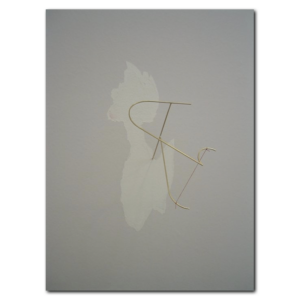
Exhibition catalogue, published by Hauser & Wirth
Texts (eng.) by Peter Stevens, Michelle White, Neil Wenman
144 p. with 80 colour illustrations and 50 illustrations in duotone
Format 30 x 20.5 cm, linen with dust jacket
David Smith (1906-1965) is widely recognised as one of the outstanding artists of the 20th century. Conceptually, a distinction between sculpture, painting and drawing was no longer an option for him. His works derive much of their power from this radically open approach. Even if the pure physicality of the welded steel sculptures has a strongly industrial appearance, their surfaces are always characterised by gestural and haptic appearances, which are created by applying paint by hand. The impact of his work lies, among other things, in his insistence that sculpture has the same visual significance as painting and drawing, and that painting and drawing have the same spatial effect. This catalogue covers 21 works, from the late 1950s to 1965, and thus documents his development with the help of rich visual material, including historical photographs from the archive of David Smith's estate. David Smith, born in 1906 in Decatur, Indiana, first attended college at Ohio University, among others, and moved to New York in 1926, where he began studying at the Art Students League. In the early 1930s, he focussed entirely on sculpture, welding together constructions from found objects and forged metal. In 1940, he moved to Bolton Landing, outside New York, where he set up a studio in a factory building, richly equipped with industrial materials and tools. From the late 1950s onwards, he created monumental works in the hilly landscape surrounding his studio. In 1965, David Smith died in a car accident near Bennington, Vermont. David Smith paved the way for artists such as John Chamberlain, Mark di Suvero, Donald Judd and Richard Serra, as it was he who freed the site of sculpture production from the restrictions of the 19th century artist's studio and the art foundries and linked it to the industrial context of the 20th century.