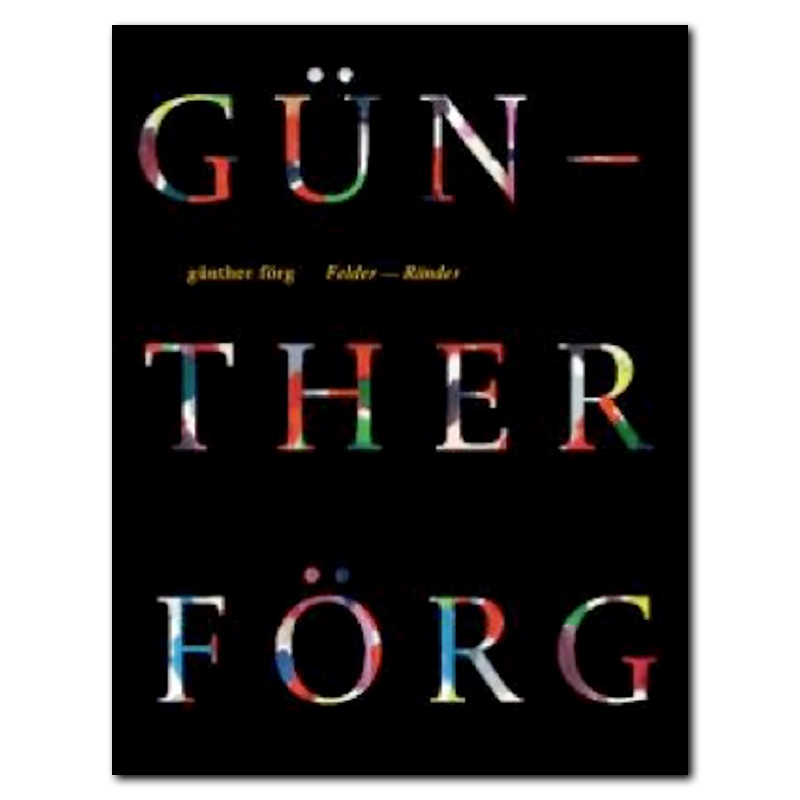
Günther FörgFelder – Ränder/ Fields and Verges
148,00 €
inkl. MwSt. und zzgl. Shipping costs
- 2007
- 144 pages
- 32 × 24 cm
- 100 colour illustrations
- linen binding, cover and spine embossing, double-folded dust jacket
- ISBN: 978-3-936859-65-2
- Edition: Italian, German, English
- Texts by: Rudi Fuchs, Max Wechsler
- Design: Rutger Fuchs, Amsterdam
Fearless Förg … writes Rudi Fuchs, and continues: “There is a certain chronology in Günther Förg’s work: when he first used a particular strategy, and what followed from it. Yet in view of his way of working it has little significance. In his abstract phase Mondrian, it seems, made one variation after another, each more precise than the one before. In his art there is the idea of progress. Günther Förg, by contrast, moves in circles. There is therefore no reason why a particular design should not be used once again. With every new application of a design, new effects will come to light, entering his ever-growing repertoire as pictorial knowledge. Consider, for example, the following design: painted grids of rather short, intersecting lines. The grids can be loose or compact, rich or sparse in colour. Finally, one can also vary the length of the lines, or combine fragments of different grids loosely and at random into a kind of collage. In the Zurich exhibition shown recently I also saw a painting with a very dense grid in flaming red, more luminous than any I had ever seen before. Another new invention: evidently the grid method, used in the relaxed manner in which Günther Förg employs it, is inexhaustible. He is an adventurer. The early masters of abstraction felt the urge to control their practice. They were very circumspect, Mondrian and Malevich. From their writings we know to what a great extent they regarded their art as spiritual. They needed that sense of affirmation. Schwitters and Miró were less bound to principles, but still carried with them, as a responsibility, the philosophical singularity of making abstract art. Günther Förg concerns himself with none of these impediments. This is why, in his laconic devising of pictorial constructions, he is able to unfold and carry through the entire spectrum of visual richness that abstract art alone can offer. After a long career of geometric art, his great colleague Sol Lewitt began to make colourful drawings with sweeping, undulating lines. A breach of principle? That was what some critics thought: Sol had gone astray. Why, they asked? Sol was silent for a moment and then said: Why not? Indeed. This is the point that abstract art, that grand modern invention, has reached, in Günther Förg’s work too – the comprehensive, unrestricted, fearless command of all its means and ways.”