Günther Kebeck, Andreas Karl SchulzeÜbersummativität
24,80 €
inkl. MwSt. und zzgl. Shipping costs
- 2019
- 96 pages
- 24 × 17 cm
- 34 colour illustrations
- hardcover
- ISBN: 978-3-86442-299-7
- Edition: German
- Texts by: Gütnher Kebeck
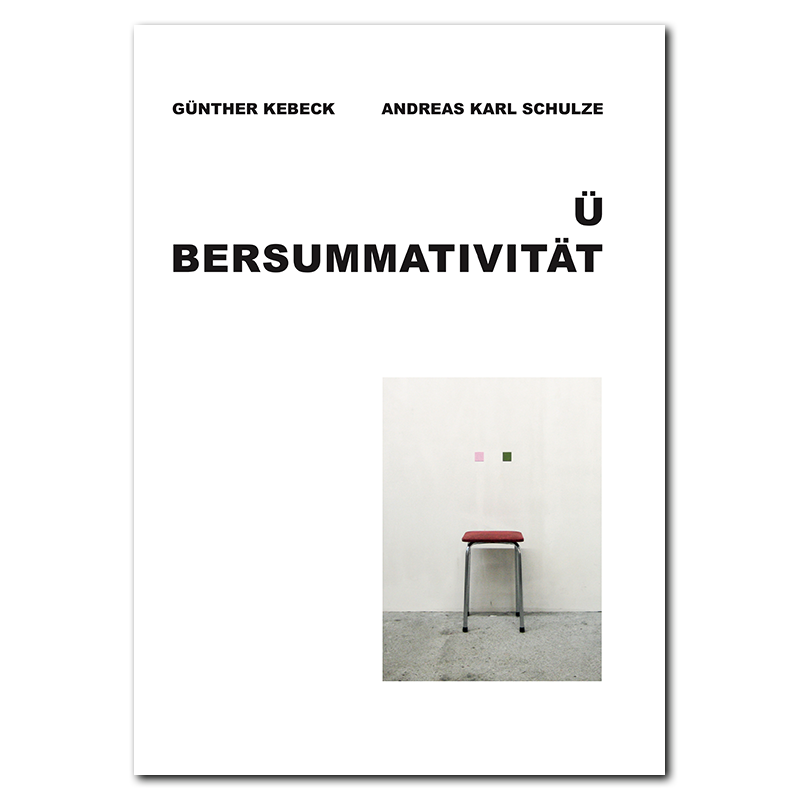
Seeing is so self-evident to us that we never ask how our visual world comes into being. But the retinal image, the starting point of human perception, bears scarcely any resemblance to what we see. Our picture of the world is generated in the brain according to fixed rules: the laws of segmentation and grouping. These are rapid, automatic processes to which our consciousness has no access. They generate the order of the visible world. Max Wertheimer presented the pioneering research on this in 1923. And what is the current state of research? Segmentation and grouping are subjects of science as much as of art. The artistic works by Andreas Karl Schulze shown here play with the regularities of seeing. On the one hand they generate new “Gestalten”; on the other they provoke precisely those ambiguities that are to be avoided in everyday life. They bring the rules of construction of the visual world into productive contradiction, permit unfamiliar conjunctions and articulate the familiar world anew. Coloured cotton squares measuring 5 x 5 cm permit almost infinite variation in the way they are arranged. Sorted by colour, the squares are kept in boxes and travel around the world as little packets of energy. They form a mobile and flexibly deployable artistic apparatus which, in the conceptual reduction of its formal means, remains extremely spare. Its perception, by contrast, is complex. They are picture and object at once; nothing can be concluded as form, everything has rhythm and is in motion. The viewer sees what is visible. This concentration on the visible signifies no limitation but is – as the art historian Erich Franz has put it – “an inexhaustible expansion of what there is to recognise.” Seeing itself becomes an experience. For this book, 34 photographs of painting installations by Andreas Karl Schulze from the years 1998 to 2016 have been selected. The text by Günther Kebeck pursues the question of how ambiguities can be reduced with the help of the processes of segmentation and grouping, and how the order of the visual world is thereby built up step by step. How parts are assembled into a whole in such a way that a supersummativity finally results: the whole is more than the sum of its parts. The reflections on the productivity of human perception are the starting point for questions of aesthetics. Why do we find things beautiful? What is special about the perception of works of art? At first glance the contrast between the scientific text and the artistic works could not be greater: reading versus looking, reflection versus contemplation. Text and pictures remain autonomous. What they share is the concentration on seeing as a fundamental act of cognition.