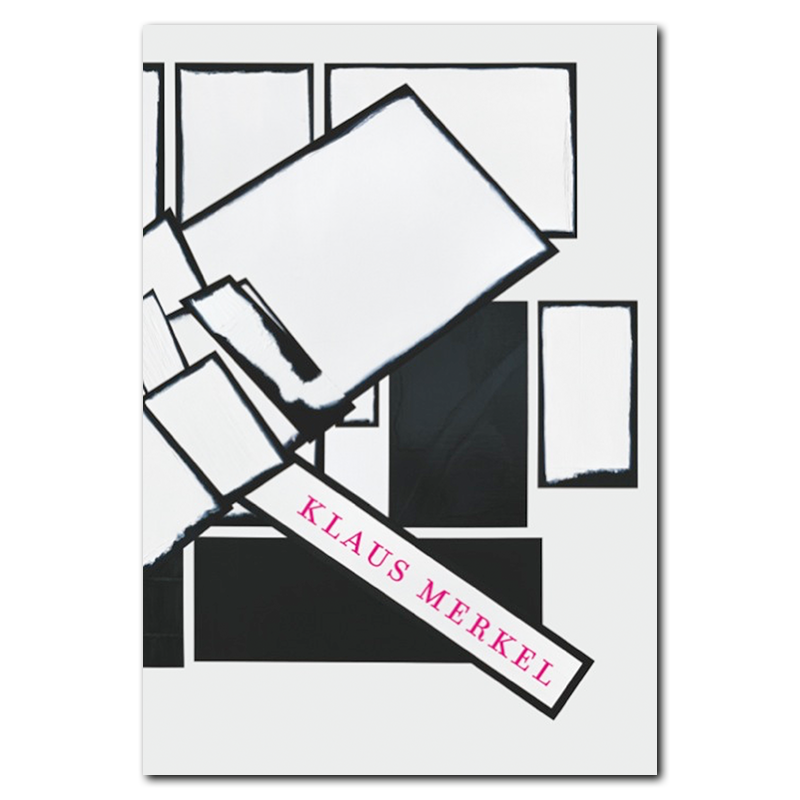
Klaus Merkelhornbook
inkl. MwSt. und zzgl. Shipping costs
- 2013
- 224 pages
- 24 × 16,5 cm
- 165 colour illustrations
- softcover with dust jacket
- ISBN: 978-3-86442-073-3
- Edited by: Jochen Kienbaum
- Design: Fahnert und Koch, Köln
- Kienbaum Artists’ Books 2014
What is the “hornbook”? What is special about “Hornbook,” the 2014 volume of the Kienbaum Artists’ Books by Klaus Merkel, is a sequencing of the 165 pictures in this volume that is appropriate to his working method and his exhibition practice. For the artist invariably forms series of pictures, clusters or rhythms in order to mark the signs in his pictures as signals of form and colour without messages. He himself has said of this that one sees „only what comes across through subjective mood. The pictures have no ’narrative‘, nor are they there for the processing of ‚abstractions‘. You can either perceive them physically or you can reject them.“ This can also describe representational signs, except that they no longer make the picture a site of narration, so that it has no mimetic function whatsoever. To this end the artist makes use of a palette of few colours, namely green, red, yellow, black and sometimes blue. Hans-Joachim Müller writes on this in his entry in the Kritisches Lexikon der Gegenwartskunst: “What is narrated, if such a thing can exist at all, is a non-linear, undirected narrative; what is narrated is the continuum of the pictures, which knows no direction, which stretches and extends in all directions, which reaches deep into the history and origin of the pictures and just as deep into the wide space of their possibilities and horizons.” That chance, too, is mobilised here as a giver of images is perhaps made clear by the way the artist arrived at the title of this book. Klaus Merkel has installed a dictionary on his computer that spits out a random word for him every day. Hornbooks, for their part, were alphabet tablets carved in horn with which children in England and the USA were once taught to read.