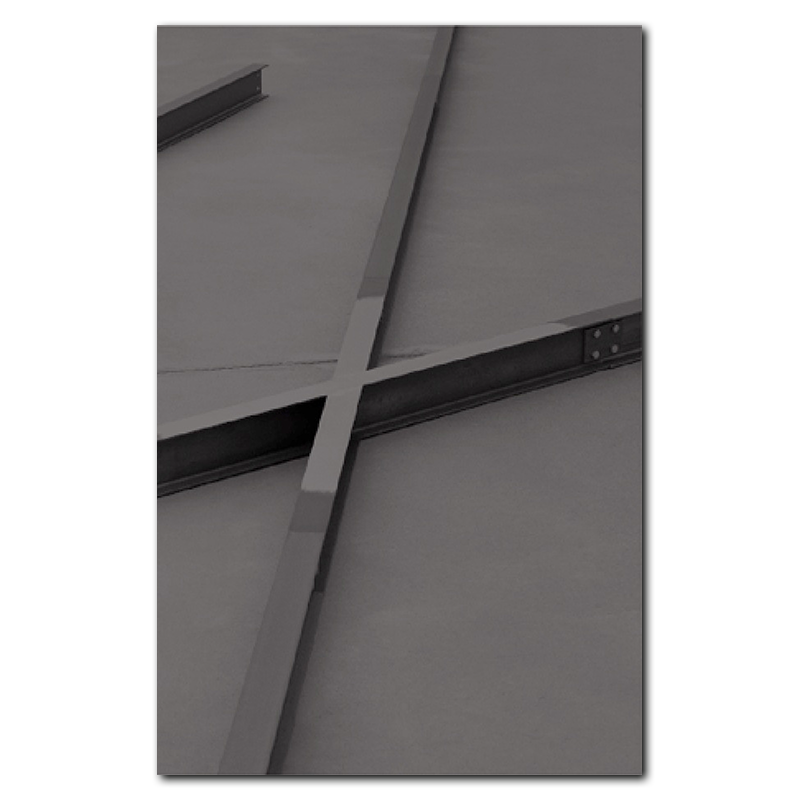
Natalia Stachon
inkl. MwSt. und zzgl. Shipping costs
- 2013
- 164 pages
- 24,5 × 16 cm
- 100 colour illustrations
- hardcover
- ISBN: 978-3-86442-036-8
- Edition: German, English
- Institution: Daimler Art Collection
- Edited by: Renate Wiehager, Christian Ganzenberg for the Daimler Art Collection
- Texts by: Renate Wiehager, glossary by Christian Ganzenberg
Spaces – Stages – Fissures: Natalia Stachon’s works neither can nor wish to deny their kinship with early modernism or with Minimal Art, for they too are concerned with the sculptural unfolding of space as a sensation, as an interstice and an atmospheric volume. These sculptural images of space by the artist – born in 1976 in Katowice, Poland, and living today in Berlin – are immediately comprehensible if one imagines a tactile, geometrically constructed sculptural volume that is fused by its opposite, an unbounded luminosity, that is, immaterial light, into the density of a medium without objecthood, as the editor Renate Wiehager writes. Accordingly, Natalia Stachon’s work is based on a precise analysis of the spatial constructions and sculptural minimalisations of the abstract avant-gardes, from the visionary spatial concepts of the Russian and Polish avant-gardes of the 1920s through Concrete Art to Minimal Art. She has, however, transformed the sculptural, work-like propositions of her predecessors into open spatial constellations of architectural dimensions. Transparent materials that guide the direction of the gaze, as well as three-dimensional bodies – in a combination of language, drawing and sculpture she allows all of this to become mental, ephemeral volumes. Walter Benjamin coined the term “dialectical image” for such a transformation, in which past is interwoven with present. Extreme transparency as a design feature also appealed to Natalia Stachon in this book. She decided to use a lightweight India paper for the plate section, which allows an interpenetration of images and of thoughts corresponding to her works by Robert Morris, Carl Andre, Gordon Matta-Clark, Adam Caruso, John Hejduk, Robert Graves, Maurice Blanchot and Nickel van Duijvenboden.