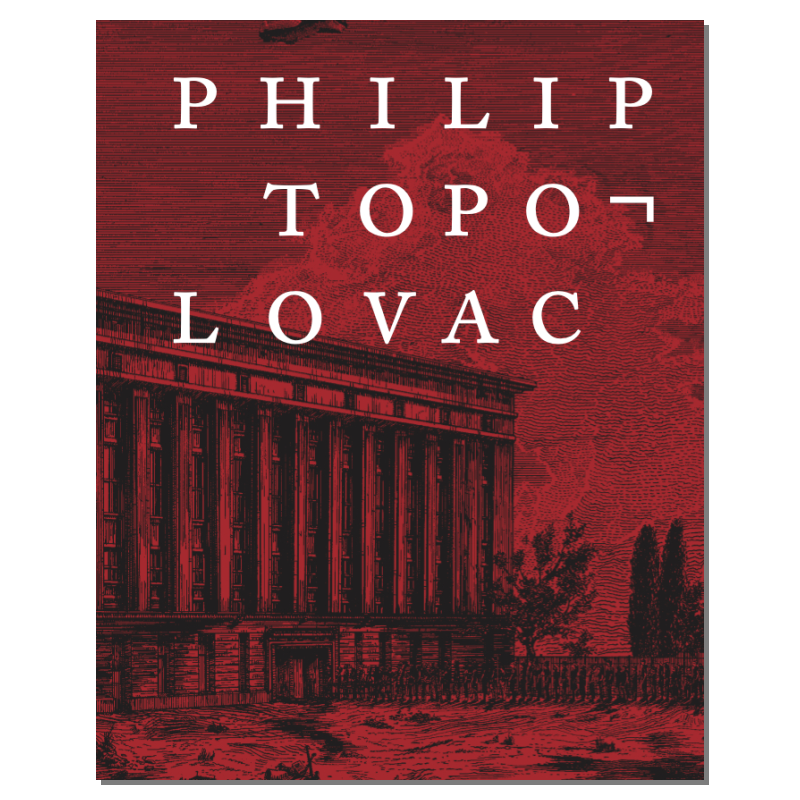
Philip Topolovac
58,00 €
inkl. MwSt. und zzgl. Shipping costs
- 2026
- 208 pages
- 30 × 24 cm
- 195 colour and 50 b/w illustrations
- linen binding embossed
- ISBN: 978-3-86442-472-4
- Edition: German, English
- Texts by: Knut Ebeling, Christine Heidemann, Anne Waak, and with a conversation between Max Dax and Alexander Kluge about the rubble sites of Berlin
- Design: Andreas Koch
In his projects, heterogeneous at first glance, Philip Topolovac analyses the conditions under which we perceive reality and asks about the meaning we attribute to what we perceive. What is real? What is historically determined? What do we appraise according to its value? Is our world really the way we have learned to imagine it? For the artist, the making of art is a subject that takes place above all in the mind of the viewer – perception as projection and interpretation is a central theme in many of his works. The aim of this publication is therefore to record the common thread running through Topolovac’s works. The world as a model, the artwork as a prop – this central aspect of his oeuvre is also reflected in the recent series “Propheten” (2025), for which “ecstatic” facial impressions taken from Baroque clay models for figures of saints are formed into lifelike head models made of polystyrene and modelling clay. As a sculpture, he has also rebuilt a concrete column repurposed as a fountain (2023) from the beer garden of Berghain. In addition, in recent years Philip Topolovac has succeeded in assembling an extensive collection of war-destroyed objects that he has salvaged from building pits in Berlin. Since reunification, the many areas of post-war wasteland along the strip of the Wall and in the rest of the divided city have been built on at high pressure. In this, the property boom opens only a small window onto the dramatic past, from which testimonies of the far-reaching destruction of Berlin during the war keep welling up. The contaminated legacies destined for disposal push up out of the ground as if out of the city’s subconscious. The work “Orpheus” comes from a similar context – although it is considerably more dreamlike: a weathered head that can be seen as a floating sculpture in a Berlin lake, from which arias from Gluck’s opera “Orfeo ed Euridice” (1762) sound at varying intervals. In Topolovac’s work, the tragedy of myth and of reality always merges into surreal picture puzzles and in this way stands for the genesis of this book.
Book launch: 6.30 p.m., 23/4/2026, Café Dix, at the Berlinische Galerie