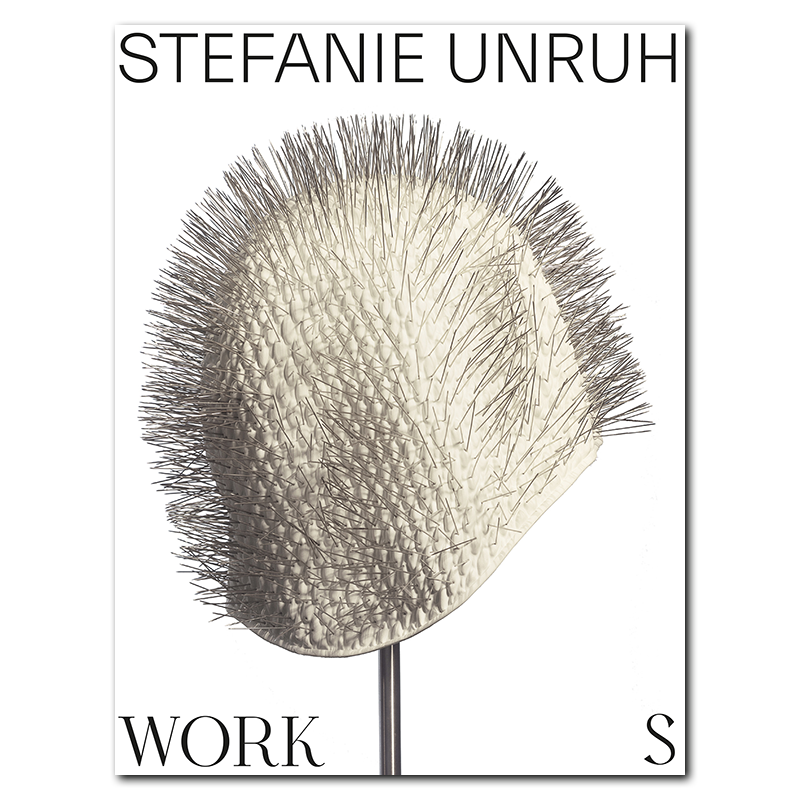
Stefanie UnruhWorks
inkl. MwSt. und zzgl. Shipping costs
- 2021
- 160 pages
- 27 × 20,5 cm
- 126 colour illustrations
- softcover with dust jacket
- ISBN: 978-3-86442-329-1
- Edition: German, English
- Texts by: Detlef Hoffmann, Rasmus Kleine, Karl Borromäus Murr, Sophie Charlotte Opitz, Carla Schulz-Hoffmann, interview with the artist by Stefanie Rosenthal
In her new book, Stefanie Unruh draws up a kind of interim balance of her work from 2000 to the present day. Carla Schulz-Hoffmann has described the core of the Munich artist’s oeuvre as follows: “In large, thematically coherent groups of works she addresses a classic question of artistic existence, its position within its respective history.” Unruh thus negotiates questions of identity, engaging with traces and memories, with everyday actions and situations, while casting reality in a surreal light. Her examination of the myths of everyday life is decisively shaped by her interest in media phenomena. In 2005/2006, for instance, Stefanie Unruh supplemented a subtle series of black-and-white floral patterned wallpapers with drawn portraits so skilfully that only on closer inspection do the photographic sources come back to mind: Mohammed Atta and his accomplices, and the famous image of the turbaned Ramzi Binalshibh, who is currently waiting in Guantanamo for the start of his trial, announced for 2021, for involvement in the attacks of 9/11, emerge from a tendril of flowers. In 2010 Stefanie Unruh took up the combination of the floral with motifs alluding to Islamism once again in ink drawings that are as simple as they are effective: out of the sweetly ornamental, which corresponds to the Islamic ban on images, the “uniform” of the burka emerges like a foreign body, and one of the women is also holding a pistol. Yet drawing, as a recurring point of departure in Stefanie Unruh’s work, marks only one of her skills in the various media – she works with equal virtuosity with objects and video installations, with which she makes her frequently solicited contribution to current debates about the occupation of public spaces. In doing so she not infrequently inverts their formal connotations: a prestigious foyer becomes a dark cave, a former tram shelter mutates into a ballroom.