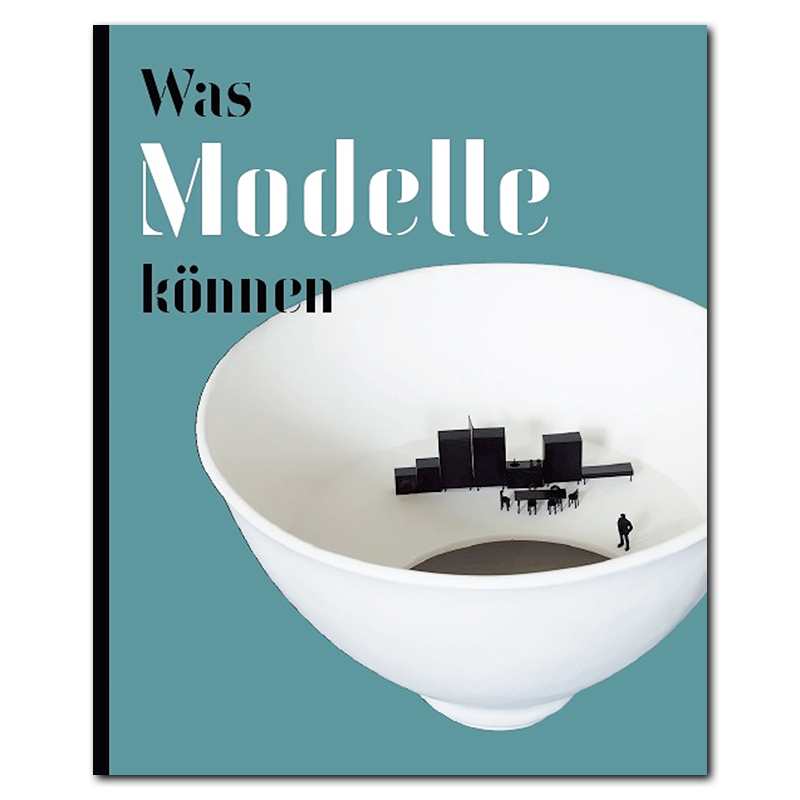
Was Modelle können
inkl. MwSt. und zzgl. Shipping costs
- 2014
- 168 pages
- 19,5 × 16 cm
- 160 colour illustrations
- softcover with dust jacket
- ISBN: 978-3-86442-095-5
- Edition: German
- Institution: Museum für Gegenwartskunst Siegen
- Edited by: Eva Schmidt
- Texts by: Martin Hartung and Eva Schmidt and with a visual essay by Stephan Mörsch
Model show! The three-dimensional architectural model – on a reduced scale – has always been and remains an aid, in the field of architecture and urban planning, in communicating planned or realised architecture. The model can efficiently convey information about larger spatial relationships that are perceived quite differently at original size, or perhaps not at all. For through its reduction in scale the model also permits a reduction of spatial complexity. Suddenly it becomes possible to see at a glance what at original size can only be experienced piece by piece, in the temporal process of walking through it. It is striking in this connection that contemporary art has frequently taken up the architectural and urban model and freed it from its narrowly defined functional context, adapting its primarily phenomenological qualities and making them fruitful for artistic questions. In the conceptually understood contemporary art of the past forty years, the architectural model is opened up poetically and used in metaphorical and theatrical ways. Also important in this context is the mysterious aura of the small, as described by Gaston Bachelard: in this way the gaze can penetrate – as if disembodied, yet always relying on bodily experience and trusting in it. On the one hand, the obvious reference to the architectural model helps here in the development and solution of sculptural questions; on the other hand, the architectural model – precisely in its condition of always remaining a design and being destined to become a realisation – can serve as an instrument of critique and as an illustration of utopia. It is precisely this both-and, the simultaneity of direct sensuous presence and of a suggestive distance from the viewer’s space of experience, that constitutes one of the fascinations of the model. Exhibition and book undertake the attempt to write a short history of the architectural model in contemporary art. It is to begin with the legendary – monumental – models of Charles Simonds and Anne and Patrick Poirier, to touch on the 1990s with Ludger Gerdes, Hermann Pitz and Thomas Schütte, and to spin the thread onward to the positions current today.
Artists:
Absalon, Michael Ashkin, Thomas Bayrle, Peter Downsbrough, Jean Pascal Flavien, Alicia Framis, Carlos Garaicoa, Ludger Gerdes, Christian Haake, Gabu Heindl & Drehli Robnik, Friederike Klotz, Langlands & Bell, Rita McBride, Isa Melsheimer, Stephan Mörsch, Sirous Namazi, Hermann Pitz, Anne & Patrick Poirier, Hinrich Sachs, Michel Sauer, Thomas Schütte, Laurie Simmons & Peter Wheelwright, Charles Simonds, Stephen Willats, Elizabeth Wright, Yin Xiuzhen
Exhibition:
Museum für Gegenwartskunst Siegen, 29/6 – 12/10/2014