Andreas Karl SchulzeP
29,80 €
inkl. MwSt. und zzgl. Shipping costs
- 2022
- 80 pages
- 24 x 16,5 cm
- 70 colour illustrations
- paperback with flaps
- ISBN: 978-3-86442-400-7
- Edition: German
- Institution: KZVWL Kassenzahnärztliche Vereinigung Westfalen-Lippe
- Edited by: Johannes Teiser, KZVWL Kassenzahnärztliche Vereinigung Westfalen-Lippe
- Texts by: Andreas Karl Schulze, Johannes Teiser
- Design: Kühle und Mozer
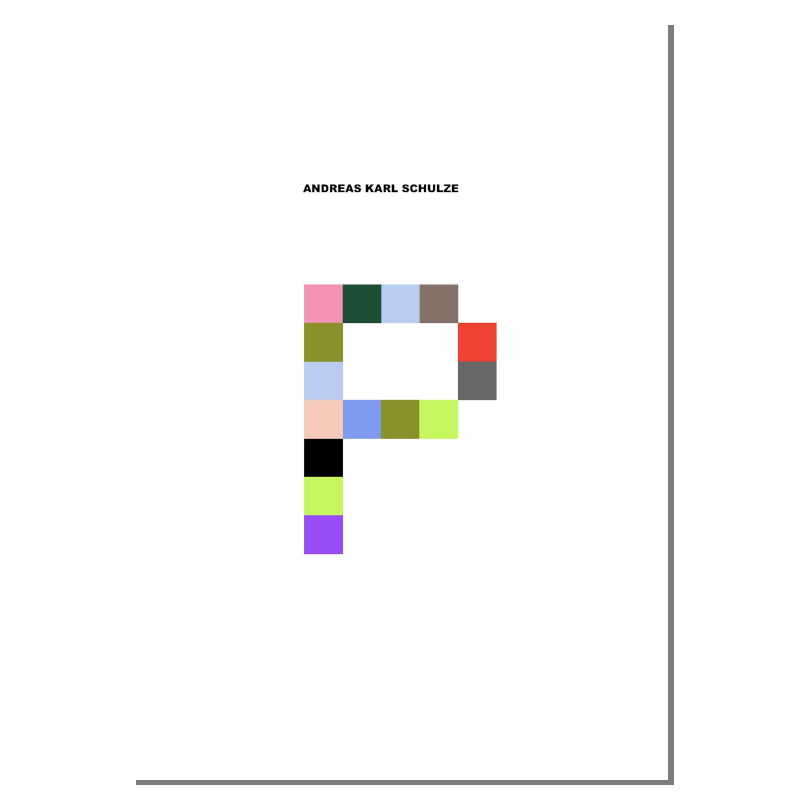
A parking deck can typically develop into a classic non-place, one that has no function beyond its use as parking space. It certainly takes some time before it becomes perceptible, but here the place names of all the district offices of the KZVWL (Kassenzahnärztliche Vereinigung Westfalen-Lippe – the Association of Statutory Health Insurance Dentists of Westphalia-Lippe) can be discovered as an enigmatic ornament. In this way, not only is a space for identification created, but the rather uninviting place becomes a space of mysterious beauty. Andreas Karl Schulze has applied many small squares to the concrete surfaces. Contemplating the cheerful, shimmering sequence of colors turns into a tentative deciphering of the coarsely pixelated letters. This leads to the gradual emergence of place names, which can then be decoded as the district offices of the KZVWL. Yet nothing here is unambiguous. Since the possibility of fluently reading what appears to be a banal list is denied, something ordinary is transformed into something special. Again and again, the process of recognition tips over into contemplation of the dancing squares. This continuous oscillation makes the experience of the artwork something extraordinary, in which aesthetic perception and the moment of identification come together – for the KZVWL is, after all, made up of precisely those district offices whose names are recorded on the walls.
P
I park. Today HRK. The day after tomorrow ÜNS. Why not take what is there and bring it together? The parking deck of the KZVWL and the list of its district offices. This source material is transformed through a very simple re-rhythmization, allowing the profane, the cryptic, the mysterious and the poetic to shine through. And it does not refuse the simultaneous option of decipherment. Welcome to the process of de- and remontage, in liberated fields of reference. Or: the faint hum of the surplus value of the parts.
Günther Kebeck says: “… Seeing becomes reading. Since simple reading fails, reading turns back into seeing. They (the letters) tend again and again to disintegrate into independent fields of colour. Although part of a form, the squares preserve their autonomy. Not only the letters but also the squares are seen as figure. He (the viewer) simultaneously experiences the continuous disintegration and reconstitution of a form. It (the gaze) moves freely, becomes restless and leaps; alternates between the whole and the individual. Contemplation takes the place of understanding. (…) Purpose-bound structure vs. aimless roaming. All this coalesces into a plane of high complexity that permanently eludes any final solution. Thinking becomes visual, and an inner, emotional stirring sets in. This shift happens unobtrusively, almost in passing. Nothing more.”
AHA. I say: “I park. Pink next to olive. Dark turquoise and violet. Black next to grey and red. Tomorrow MMH. The day before yesterday VEL. I park.” AKS 2021
