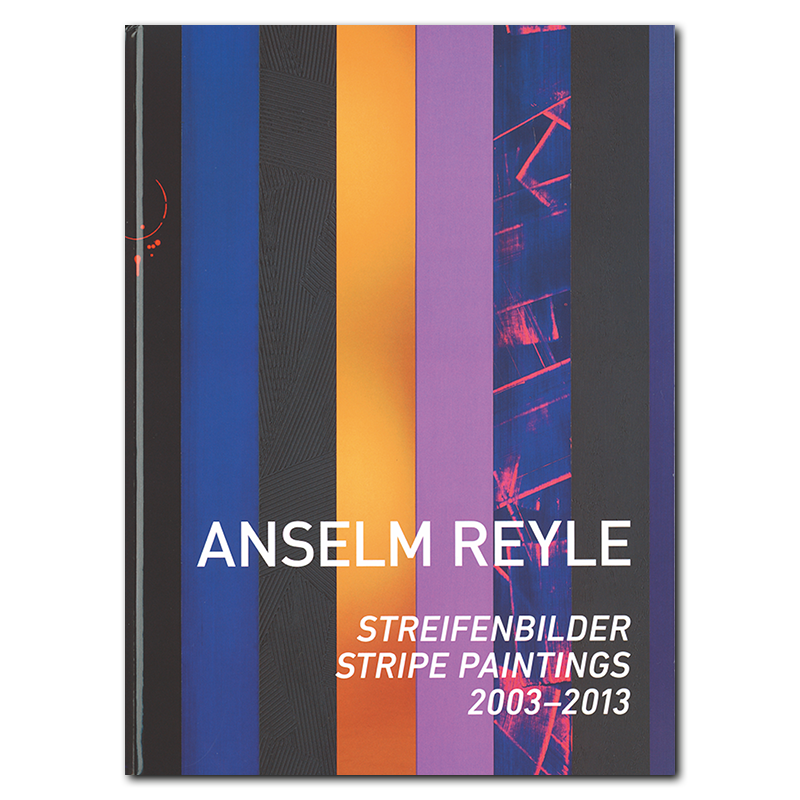
Anselm ReyleStreifenbilder 2003–2013
inkl. MwSt. und zzgl. Shipping costs
- 2015
- 32 pages
- 32,5 × 23,5 cm
- 18 illustrations in 7-colour printing
- hardcover
- ISBN: 978-3-86442-155-6
- Edition: German, English
- Institution: Contemporary Fine Arts CFA Berlin
- Edited by: Bruno Brunnen and Nicole Hackert
- Texts by: Anna-Catharina Gebbers
The stripe paintings of Barnett Newman, Kenneth Noland, Bridget Riley, Gerhard Richter, Frank Stella and Daniel Buren have long been legendary. So it seems coquettish when today a really rather successful but still young fellow artist comes along and sets out to pour old wine into new bottles. But is that what he is actually doing? The excellent small volume, which offers a good insight into this very well-known group of works by Anselm Reyle, makes it unambiguously clear through its elaborate production with seven-colour printing that here stripes are not simply stripes and that, while the new remains connected to the old, it nevertheless adds something entirely new to it. And this new element does not consist solely in the particular colourfulness of Anselm Reyle’s stripe paintings. For, first and foremost and as always in painting since the beginning of the twentieth century, what is at stake is an attitude – or, in Carl Andre’s words: „Frank Stella’s painting is not symbolic. His stripes are the paths of brush on canvas. These paths lead only into painting.“ Anselm Reyle sees it in much the same way and adds to Carl Andre’s statement: „… whether that happens to be foil I found in a shop window, or found objects from recent art history, such as stripe paintings.“ In doing so, Reyle always uses the (found) materials as media of research: why do we perceive certain combinations of colour and material as harmonious, and others as drastic? Why does one colour-material combination exert an appeal and another not? To what extent are these judgements culturally conditioned? How can such conditioning be revised? Formally, the readymade is at work in Anselm Reyle’s intensifications, its language consisting of one-to-one appropriations, enlargements or quotations of material and colour, and the artist sees it as part of the world of commodities, which he accordingly conceives of as a gigantic readymade ensemble. Indisputably, the particular achievement of these paintings lies in their permanent, drastic transformation, which, while remaining committed to contemporaneity, heads straight for timelessness.
Exhibition:
CFA Contemporary Fine Arts Berlin, 1/10 – 14/11/2015