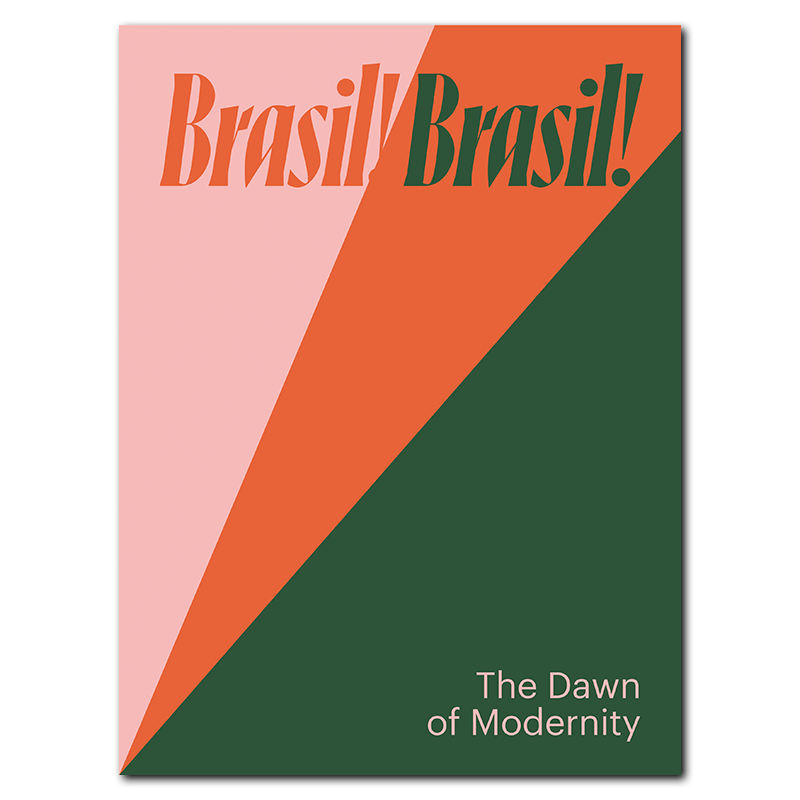
Brasil! Brasil! The Dawn of Modernity
48,00 €
inkl. MwSt. und zzgl. Shipping costs
- 2024
- 304 pages
- 280 x 210 mm
- 200 colour illustrations
- softcover with flaps
- ISBN: 978-3-86442-441-0
- Edition: English
- Institution: Zentrum Paul Klee Bern, Royal Academy of Arts London
- Edited by: Fabienne Eggelhöfer, Nina Zimmer
- Texts by: Gênese Andrade, Anna Paula Cavalcanti Simioni, Eduardo Jorge de Oliveira, Adrian Locke, Alecsandra Matias de Olivereia, Fabienne Eggelhöfer and Roberta Saraiva Coutinho, Giancarlo Hannud, Cacá Machado, Guilherme Wisnik, foreword by Nina Zimmer, with comprehensive chronology and bibliography
- Design: Flávia Nalon, ps.2 arquitetura + design, Hamburg
Brasil! The Dawn of Modernity! In the winter of 1944 the Royal Academy of Arts staged the “Exhibition of Modern Brazilian Painting” for three weeks in its large neoclassical main galleries. The title of the show is somewhat misleading, for it was in fact two different exhibitions in one: the first, the „Exhibition of Modern Brazilian Painting“, comprised 80 paintings and 86 works on paper shown in two galleries; and the second, “Brazil Builds,” contained 192 photographs and occupied a single gallery. Between 1947 and 1948 the Museu de Arte Moderna de São Paulo (MAM-SP), the Museu de Arte de São Paulo (MASP) and the Museu de Arte Moderna do Rio de Janeiro (MAM-RJ) all opened, and one art critic described these initiatives as a “sign of Brazil’s desire to communicate with its own artists and to connect with those international centres of artistic expression.” Not long afterwards, in 1951, Brazil inaugurated the Bienal Internacional de São Paulo: the world’s first biennial exhibition after Venice and a demonstration of the value Brazil attached to art and culture at the time, underlining its determination to be part of the emerging international art scene of the post-war years. The “Semana de Arte Moderna” (Week of Modern Art) of 1922 is regarded as the starting signal for the development of a Brazilian modernism, from which a first generation of artists emerged, among them Anita Malfatti (1889–1964) and Vicente do Rego Monteiro (1899–1970). The genuinely Brazilian aspect of this modernity, as postulated by the writer Oswald de Andrade, was to be the role of “national identity.” In a manifesto he called for foreign European culture to be devoured, “digested” and, through its transformation, put to use in forging an independent Brazilian art. This also included the “devouring” of Indigenous and Afro-Brazilian cultures. The two artists named above, and further protagonists such as Lasar Segall (1891–1957) and Tarsila do Amaral (1886–1973), are today held to have maintained a certain social distance from Indigenous imagery and Afro-Brazilian ritual, a distance that was finally overcome by a second generation around Djanira da Motta e Silva (1914–1979) and Rubem Valentim (1922–1991). Today all these artists and their works are causing a stir in exhibitions such as „Foreigners Everywhere“ at the 60th Venice Biennale (curated by Adriano Pedrosa), because after the “digested” formalist conquest by European modernism an entirely distinctive visual language emerged in their work. International interest in the concept of a global modernity has been pronounced for some considerable time, and scholarly parallels with the challenges of European modernism are addressed just as much as the political, social and cultural differences. In the exhibition and in this comprehensive publication, “Brasil! Brasil! – The Dawn of Modernity” presents the various ways in which Brazilian artists developed their distinctive modern visual language, while its presentation of ten artistic positions at the same time provides an introduction to the formative political, social and economic conditions; key moments in literature, music, design and architecture are addressed as well. A first opportunity for intercultural exchange presented itself to the Zentrum Paul Klee in 2019 with the exhibition “Paul Klee – Unstable Balance,” curated by Fabienne Eggelhöfer, which on its tour from São Paulo via Rio de Janeiro to Belo Horizonte was received with great interest by Brazilian audiences.
Artists:
Anita Malfatti, Vicente do Rego Monteiro, Tarsila do Amaral, Candido Portinari, Lasar Segall, Flávio de Carvalho, Alfredo Volpi, Djanira da Motta e Silva, Geraldo Barros, Rubem Valentim
Exhibition:
Zentrum Paul Klee Bern, 7/9/2024 – 5/1/2025
Royal Academy of Arts, London, 28/1 – 21/4/2025
*The exhibition is organised by the Zentrum Paul Klee Bern in collaboration with the Royal Academy of Arts London!