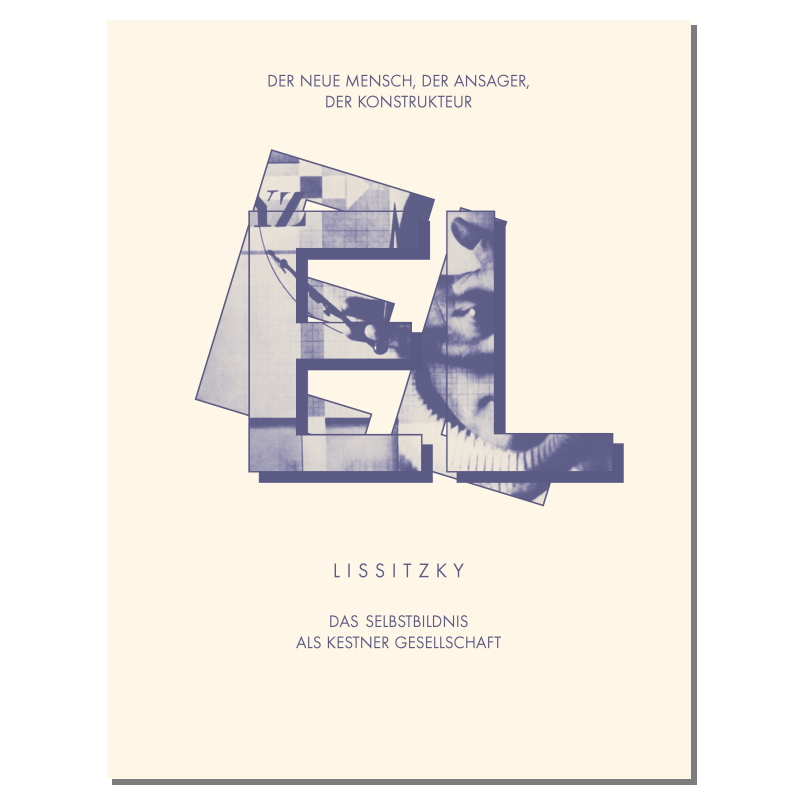
EL LISSITZKY. Der Neue Mensch, der Ansager, der Konstrukteur. Das Selbstbildnis als Kestner Gesellschaft
48,00 €
inkl. MwSt. und zzgl. Shipping costs
- 2025
- 192 pages
- 20 × 26 cm
- 80 colour illustrations
- paperback with flaps
- ISBN: 978-3-86442-458-8
- Edition: German
- Institution: Kestner Gesellschaft Hannover
- Edited by: Alexander Wilmschen
- Texts by: Kai-Uwe Hemken, Ines Katenhusen, Peter Rautmann, Marcelo Rezende, Gabi Sand, with an intro by Adam Budak and a foreword by Alexander Wilmschen
- Design: ItYt Hannover
At breathtaking speed – EL LISSITZKY – What connects “Zabriskie Point,” Michelangelo Antonioni’s cult film of the 1970s, of the student revolt and the hippie movement, with El Lissitzky, and what connects BEASTER, Johanna Billing, Martin Boyce and all the other contemporary artists with his visions as an architect, designer, artist and photographer? One of the many answers is that, through his revolutionary handling of art, space and typography, El Lissitzky (1890–1941) achieved an integration of visual elements into a dynamic and interactive legibility of what is depicted. The breathtaking speed he adopted in doing so was bound up with the “sound” of the 1920s, especially in Germany, where between 1909 and 1914 El Lissitzky had studied engineering at the TU in Darmstadt, after being refused a place as a Jew at the art academy in St Petersburg. This explains his shuttling between Moscow, Berlin, Cologne, Zurich and Hanover, which led him to countless projects by and with Kurt Schwitters, Hans Arp, Jan Tschichold or Willi Baumeister. He is regarded not only as one of the theoretical minds of Constructivism, later teaching at various Russian colleges; with Ilja Ehrenburg he also published the art magazine “Gegenstand” in Berlin, where in 1922 he was involved in the “Erste Russische Kunstausstellung,” he was artistic director of the Soviet pavilion at the press exhibition known as “Pressa” in Cologne in 1928, and in 1929 he designed the section of Soviet artists for the Werkbund exhibition “Film und Foto.” In Hanover, at the invitation of the Kestner Gesellschaft, he had already designed the “Proun” portfolio in 1923, a portfolio of lithographs and collages; it was followed in 1928/29 by the commission from the Niedersächsische Landesgalerie to design the “Abstraktes Kabinett.” Proun is the abbreviation of “Pro Unowis” and stands for the “founding of new forms in art.” This means an unbounded, utopian space in which the structures float weightlessly and are defined not only by height, width and depth but also by an abstract magnitude, “time.” The exhibition at the Kestner Gesellschaft, at once a reminiscence of its great achievements and of its historical significance, took place on the 100th anniversary of the publication of the Proun portfolio and stands for the development of the international, progressive new art movements that link artists such as El Lissitzky or Kurt Schwitters in one breath with the name of the Kestner Gesellschaft. Katja Strunz takes this up when she says: “My work revolves around the interweaving of time, space and movement. The phenomenon of falling and folding runs through all my works and stands metaphorically for a compression of space and time, the collapse of here and there, of now and then. I am interested in how change manifests itself spatially and temporally and which processes trigger transformations. Through the rhythm of unfolding and folding I want to capture a moment in time.” From a contemporary perspective she thus sums up the important impulse that emanates from El Lissitzky’s oeuvre as a whole, and at the same time supplies for the exhibition of summer 2023 at the Kestner Gesellschaft Hannover the connection that this book now actually documents.
Artists: Michelangelo Antonioni, Willi Baumeister, BEASTER, Johanna Billing, Martin Boyce, Max Burchartz, Heinrich Dunst, the next ENTERprise, Fernanda Fragateiro, Assaf Gruber, John Wood and Paul Harrison, Lajos Kassák, Marlena Kudlicka, Marysia Lewandowska, El Lissitzky, Felipe Mujica, László Moholy-Nagy, Paulina Ołowska, Peter László Peri, Prinz Gholam, Florian Pumhösl, Susanne Sachsse, Wieland Schönfelder, Kurt Schwitters, Katja Strunz, Nikolai Michailowitsch Suetin