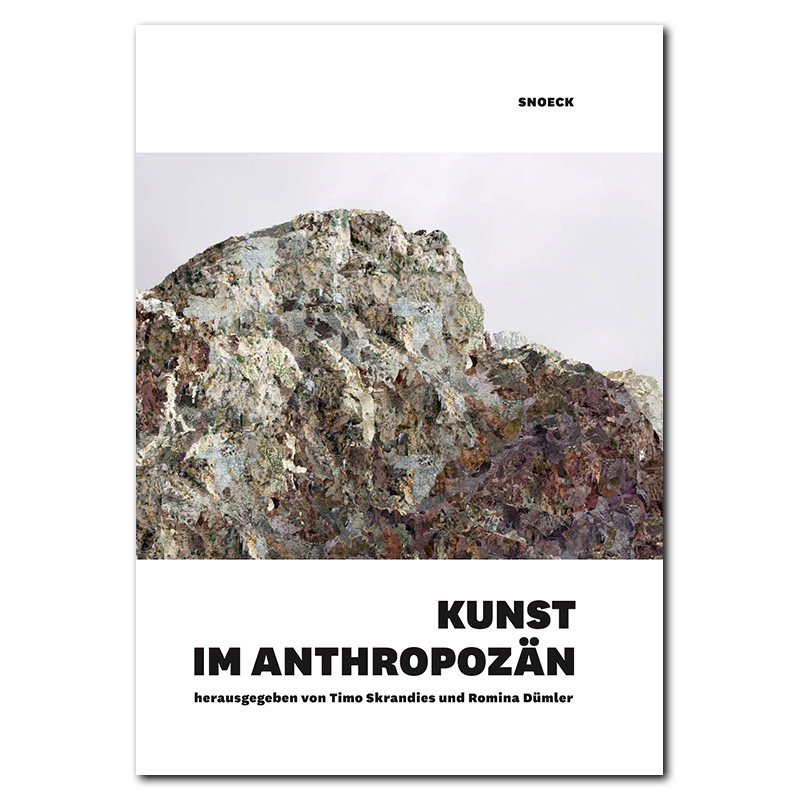
Kunst im Anthropozän
39,80 €
inkl. MwSt. und zzgl. Shipping costs
- 2023
- 192 pages
- 27 × 19 cm
- 50 colour illustrations
- softcover
- ISBN: 978-3-86442-296-6
- Edition: German
- Edited by: imo Skrandies and Romina Dümler, for the Heinrich Heine University Düsseldorf
- Texts by: Christof Baier, Ilka Brinkmann, Davide Brocchi, Svetlana Chernyshova, Hans Dickel, Romina Dümler and Alex Grein, Sabine Flach, Jens Hauser, Magdalena Holzhey, Anita Hosseini, Bettina Paust, Nina-Marie Schüchter, Timo Skrandies
From Beuys to landscape architecture: taking the measure of a concept – the “Anthropocene” is first mentioned in a scientific context in the year 2000; since 2007 a geoscientific commission has been devoting itself to the question of whether it should count as a new geological epoch (following the Holocene). Since the 2010s the question of a man-made geological epoch has increasingly and extensively been negotiated in the humanities and in media and cultural studies as well. As a result, considerations are moving more and more to the fore that use the „Anthropocene“ less as a historical than as a systematic category and thereby grasp functional relationships within and beyond the genres more precisely than is possible with the aid of the inherited dichotomies (such as nature–culture, subject–object). And does such a shift from dichotomies to relationalities not also harbour important political and ethical consequences? The present volume approaches this subject from the perspective of art, which has for some time – at least since the middle of the twentieth century – addressed the interconnections of human and non-human modes of existence as material, non-linear and dynamic relations. This brings into view phenomena such as environmental disasters and the decay of the landscape, climate change, biotechnological interventions, natural and social metabolisms, urban planning concepts and technical infrastructures, the hubris of human possibilities and post-humanist perspectives, material processes and ‚forces behind the forms‘. The contributions in this volume unfold a broad spectrum of themes, ranging from individual artists (Joseph Beuys, Pierre Huyghe or Lara Almarcegui, for instance) through curatorial projects to BioArt and landscape architecture.