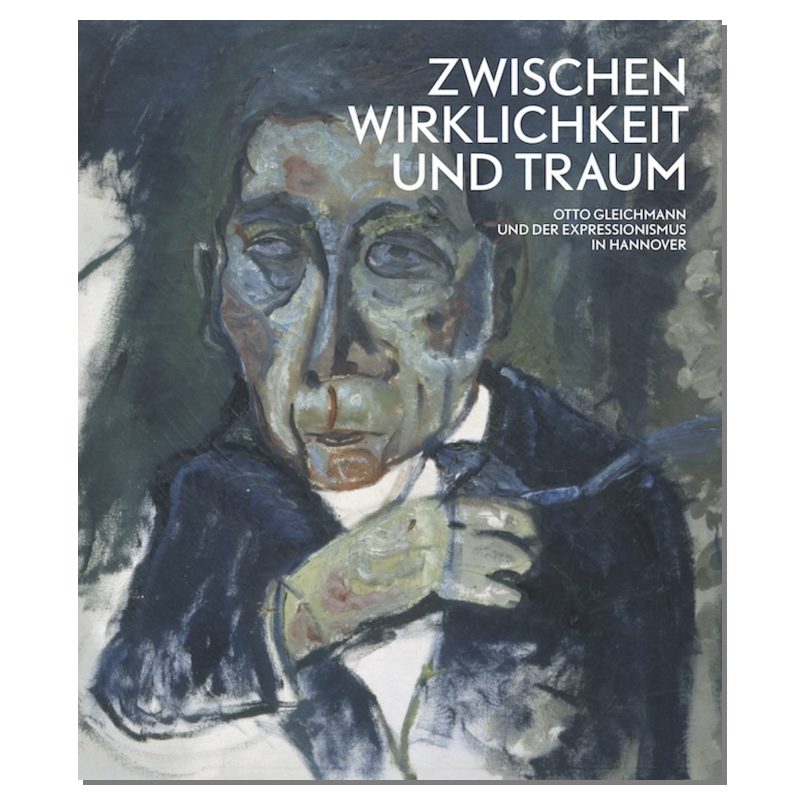
Zwischen Wirklichkeit und Traum – Otto Gleichmann und der Expressionismus in Hannover
48,00 €
inkl. MwSt. und zzgl. Shipping costs
- 2026
- 256 pages
- 26 x 22 cm
- 140 colour illustrations
- hardcover
- ISBN: 978-3-86442-488-5
- Edition: German
- Institution: Sprengel Museum Hannover
- Edited by: Karin Orchard
- Texts by: Claudia Andratschke, Katherina Herrmann, Nora Niefanger, Karin Orchard and Petra Wenzel, forword by Reinhard Spieler
- Design: Uli Schwinge, Randgruppe
Otto Gleichmann (1887–1963) belongs to the younger generation of German Expressionism. After the First World War he moved to Hanover, where he lived until his death. Despite numerous successes, above all in the 1910s and 1920s (including a first exhibition at the Kestner-Museum Hanover in 1917), he is almost forgotten today. His influence at the time, which extended far beyond Hanover itself, offers the opportunity to rediscover the work of an important painter and draughtsman. As a member of the Hanover Secession, he and his circle experienced exceptionally fruitful and vibrant years – Hanover was one of the German centres of the avant-garde. In Gleichmann’s home, the “Montmartre of Hanover,” the local artistic community met international artists: Kandinsky, Klee, Schwitters, Jawlensky, Arp, Tzara, Lissitzky and Ozenfant, among others, were guests of Gleichmann and his wife, the artist Lotte Gleichmann-Giese (1890–1975). Otto Gleichmann was thus able to take part in numerous solo and group exhibitions throughout Germany, and in some cases abroad, where his works sold well. Renowned gallerists such as Flechtheim, Nierendorf, Garvens and Schames showed his work regularly. He enjoyed a lifelong friendship with the Düsseldorf physician, collector and gallerist Hans Koch. In 1932, the Kestner Gesellschaft mounted a major exhibition of his work. Otto Gleichmann’s oeuvre is imbued with humanist pathos; his palpable sensitivity is devoted to his central theme: the human being. Stylised, unmistakable faces with wide-open eyes stand for the horrors of the First World War, which he experienced first-hand. His figures roam densely packed cityscapes or amuse themselves in variety theatres and at the circus. Throughout his life, his repertoire centred on figure paintings in manifold constellations, so that the stylistic development of individual motifs can be traced superbly across a creative process spanning almost fifty years: from the dark, suffering creature of his expressive phase, to a relaxed, self-contained inwardness from the mid-1920s onwards, followed in the late work by a brighter, lyrical, nervous hand. During the National Socialist era, Otto Gleichmann continued to work as an art teacher in the school system and therefore felt compelled to join the NSDAP in 1933. Nevertheless, in 1936 he was banned from exhibiting; in 1937 his works were confiscated from public collections and held up to scorn in the “Entartete Kunst” (Degenerate Art) exhibition. He suffered under this, but withdrew into an inner world and continued to work, leaving his pieces undated. The exhibition and book are devoted to a retrospective comprising 114 works from all of his creative periods; in addition, the work of his wife Lotte Gleichmann-Giese is presented for the first time, with 13 works.
Exhibition:
1/8–1/11/2026, Sprengel Museum Hannover